Welcome to the Evidence Revealed Education Center!
Lone Star Mastodon

The Lone Star Mastodon skull was pulled from a gravel pit near La Grange, Texas, in 2004. The skull had been shattered, and paleontologist Joe Taylor labored for over a year to put the pieces back together. When the skull was finally assembled, it was the largest mastodon skull ever found— a record that stands to this day. The skull sold at auction for over $190,000. Although mastodon skeletons are nearly identical to those of mammoths at first glance, mastodons are distinct from mammoths. The most obvious difference between the two are the shape of their teeth.
The Amargasaurus Stone

This stone artifact depicts a sauropod with long dorsal spikes. It was discovered in Peru circa 1920 and was displayed at the Museo Aeronáutico in Lima for decades. In 1984, the fossil skeleton of Amargasaurus was discovered in Argentina, and its long dorsal spines were formally described in 1991. The skeleton of Amargasaurus perfectly matches the creature depicted on the stone artifact. Those who claim the stone is a hoax must explain how the artist managed to create an exquisitely accurate interpretation of Amargasaurus 60 years before the animal was even unearthed.
Hatching Egg Ica Stone
Hatching Egg Ica Stone
Hatching Egg Ica Stone
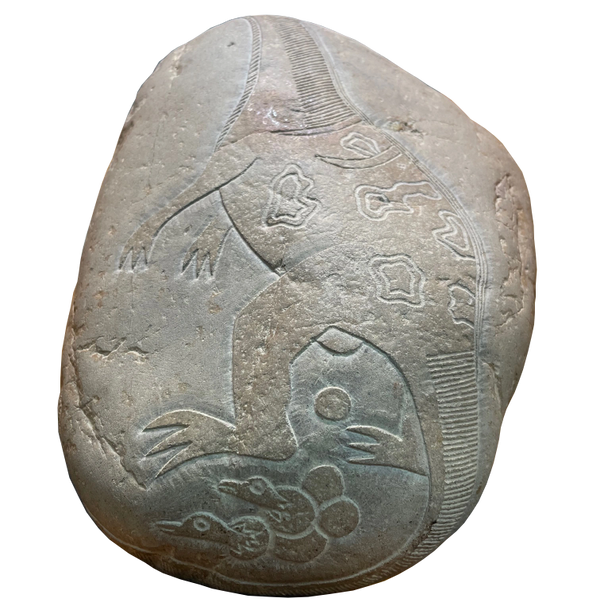
This etched stone artifact from Peru depicts a theropod or sauropodomorph dinosaur laying eggs, two of which are in the process of hatching. This artifact is an example of an Ica Stone. Ica stones are believed to predate the Incan civilization, and may be 3000 years old or more. Although fakes and forgeries of Ica stones certainly exist, many are genuine. Stones like this one suggest that human beings coexisted with dinosaurs in the past— an anachronism by Evolutionist standards, but consistent with biblical creation.
Elephant Bird Egg
Hatching Egg Ica Stone
Hatching Egg Ica Stone

This is the largest egg in history. It was laid by an Elephant Bird (Aepyornis maximus), an enormous ratite native to Madagascar that went extinct about 400 years ago. The egg is 13 inches tall and has a liquid capacity of 2 gallons— the equivalent of 7 ostrich eggs. Even dinosaurs did not lay eggs this big. This is as big as an egg can possibly be, per the laws of physics. Any bigger, and the shell would burst under its own weight. If the shell were any thicker, the chick inside could not break out.
Psittacosaurus
Psittacosaurus was a diminutive, herbivorous dinosaur species from central Asia. In life, it was roughly the size of a beagle. Psittacosaurus is special for several reasons. For one, it is one of the few dinosaurs whose skin pigments were preserved, allowing scientists to confidently conclude the animal was counter-shaded— dark brown on top and pale on the bottom. It was also determined to have long quill-like filaments growing from its tail. Most interesting of all, a juvenile Psittacosaurus was found inside the fossilized remains of a Repenomamus, a mammal closely resembling a Tasmanian devil. The mammal had eaten the baby dinosaur before it, in turn, was drowned and buried.
Fossilized Fly

This fly is one of dozens of minuscule but magnificent fossils retrieved from Green River rock samples. The Green River Formation in Wyoming yields some of the most exquisitely preserved fossils in the world. A single slab of limestone can contain hundreds of paper-thin rock layers, each containing potentially thousands of invertebrates. These include ants, flies, mosquitoes, beetles, crayfish, and isopods, as well as more substantial vertebrates like fish, snakes, bats, birds, and turtles. The ultra-fine limestone sediments preserved the tiniest features intact, down to the individual hairs on a bug's leg. The Green River Formation is superb evidence of a massive flood event.
Clarkia Leaf Fossil
This leaf fossil is one of many from the Clarkia fossil beds in northern Idaho. These leaf fossils are special because they are the first fossilized organisms from which DNA was successfully recovered and sequenced. Since DNA decays by 50% every 521 years, we are able to calculate the age of the leaves by measuring the amount of DNA remaining in the fossils. The leaves contained between 0.19 and 0.39% of their original DNA strands, corresponding with an approximate age of 4,100 to 4,700 years old. This range neatly aligns with estimates for the date of the Genesis flood, which occurred some 4,400 years ago. Some of the Clarkia leaf fossils are so well preserved, they still smell like autumn leaves when first exposed to oxygen.
Cambrian Trilobite
The trilobite not only ranks among the most iconic fossils, but also represents one of the largest and most diverse classes of animal to ever exist. More than 22,000 individual species of trilobite have been described to date, varying wildly in size and appearance. Evolutionists consider the trilobite to be one of the first complex organisms to evolve from simple marine invertebrates more than 500 million years ago. However, the irreducible complexity of the trilobite's anatomy, including its compound eyes and various specialized appendages, clearly indicate intelligent design over random chance mutations. Reports of soft tissues discovered in Cambrian-era trilobite fossils also suggest the animals are only a few thousand years old, rather than hundreds of millions. These reports will be verified when the data is published.